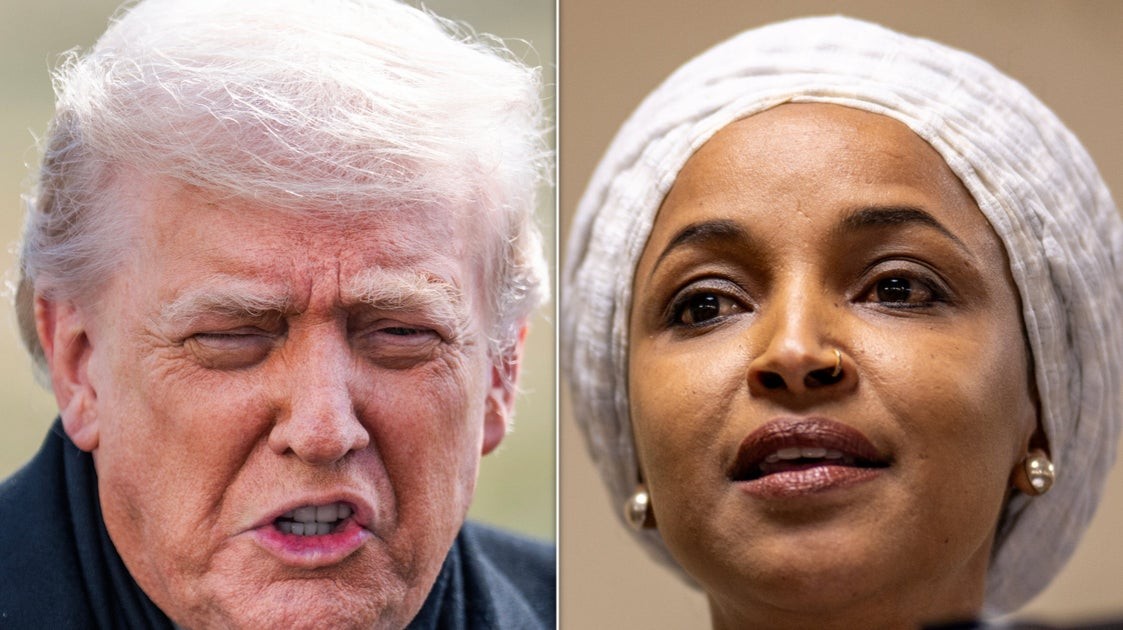
President Donald Trump faced widespread condemnation after dismissing an attack on Rep. Ilhan Omar (D-Minn.) as potentially self-inflicted, further fueling existing political tensions. The incident occurred during a town hall in Minneapolis, where a man sprayed Omar with an unknown liquid while she was speaking against Homeland Security policies and calling for accountability following recent fatal shootings by federal agents.
The Incident and Initial Reaction
On Tuesday, Omar was addressing her constituents when Anthony Kazmierczak, 55, rushed the stage and sprayed her with a syringe-like device. Kazmierczak was quickly apprehended and charged with third-degree assault. Omar, undeterred, continued her speech, emphasizing resilience in the face of aggression. She later posted on X, stating she would not be intimidated.
Trump’s Dismissive Response
When questioned about the attack, Trump claimed he hadn’t seen the video but suggested Omar “probably had herself sprayed,” adding that he doesn’t “think about her.” His remarks were immediately criticized as insensitive and reckless, exacerbating the already polarized political climate.
Historical Context and Escalating Rhetoric
Trump’s reaction is not isolated. He has repeatedly attacked Omar with racist and Islamophobic language, including recent disparaging remarks about her country of origin at an Iowa rally. This pattern of aggressive rhetoric has long been criticized for potentially inciting violence and fueling conspiracy theories among his supporters.
Expert Analysis: The Impact of Trump’s Rhetoric
Political scientists warn that Trump’s statements normalize political violence and contribute to a climate of distrust. Conor M. Dowling, professor at the University at Buffalo, noted that Trump’s comments exacerbate existing conspiracy theories, while Todd Belt, director at George Washington University’s Graduate School of Political Management, emphasized Trump’s tendency to prioritize self-interest over empathy or factual accuracy.
Broader Implications: Erosion of Trust in Facts
The incident highlights a growing trend where basic facts are disputed along partisan lines. Experts point out that Trump’s rhetoric feeds into this distrust, as does similar behavior from some on the left. The result is a polarized environment where violence is increasingly seen as an acceptable response to political disagreement.
The president’s statements stand in stark contrast to the Republicans in Congress who have spoken out condemning the attack on their colleague.
Trump’s immediate dismissal of the attack without reviewing evidence or offering sympathy underscores his consistent pattern of escalating tensions before facts are known. This behavior is seen as a deliberate strategy to maintain control over the narrative and reinforce loyalty among his base.
The incident with Ilhan Omar is another example of how divisive rhetoric can escalate into real-world violence, and how political leaders’ responses can either de-escalate tensions or further inflame them. The situation serves as a stark reminder of the consequences of unchecked inflammatory speech in the modern political landscape.