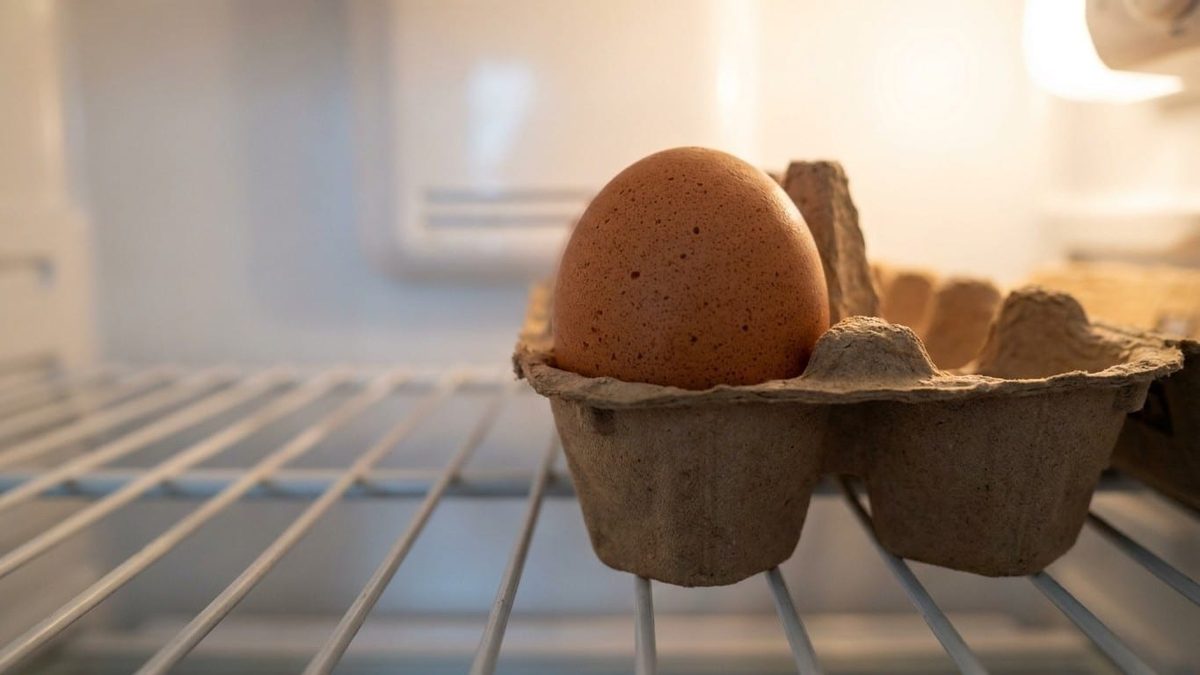
We have all done it. You open the fridge door, spot that little molded plastic indentation, and slide your carton in. It fits perfectly. It looks organized. It feels logical.
But you are making a mistake. A thermodynamic mistake.
The egg door is arguably the most deceptive feature in modern kitchen design. It promises safety. It delivers spoilage.
The Door is a Heat Trap
Let’s be clear about the physics here. The door of your refrigerator is the warmest part of the appliance. Not slightly warmer. Significantly warmer.
While the main compartment of a static fridge might hover between 0°C and 4°C, the door fluctuates between 6°C and 10°C. That is a gap of two to six degrees. In the world of food safety, that gap is the difference between halting bacterial growth and giving it a playground.
But temperature alone isn’t the enemy. The real problem is volatility.
Every time you open the fridge, cold air escapes. Warm kitchen air rushes in. The shelves deep inside resist these changes better than the door. The door is in constant flux. It takes a hit every time you grab milk or cheese.
For eggs, this cycle is fatal.
“The most important thing is not to subject eggs to temperature variations.”
When an egg experiences these warm-cool-warm cycles, condensation forms on the shell. Water is the vehicle for bacteria. Since eggshells are porous, that moisture allows germs to slip right through the pores. It is a brutal, simple mechanism.
The Cuticle Defense
Eggs are not helpless. They have a natural shield.
Just before a hen lays an egg, she coats it in a thin, invisible membrane called the cuticle (or bloom). This layer plugs the microscopic pores of the shell. It is a built-in defense system against pathogens like salmonella.
In Europe, industrial washing of eggs for direct consumption is banned. Why? To preserve that cuticle. Without washing, the shell remains protected. This is why, technically, European eggs can be stored at room temperature for up to 21 days without bacterial growth.
But putting eggs in the door sabotages this protection.
When you take an egg out and let it sit on the counter, or when it sits in the fluctuating heat of the door, condensation builds up. That moisture breaks down the cuticle’s effectiveness. It opens the door—literally—for bacteria to enter.
Where to Actually Store Eggs
If you want to keep your eggs fresh and safe, move them.
1. Move them to the middle.
Stop using the door. Place eggs on a middle shelf. The temperature there is stable. It is colder. It doesn’t swing with every time you open the fridge.
2. Keep them in the box.
Do not transfer eggs to a glass jar or a loose pile. Keep them in the cardboard carton they came in. The box protects the shells from impact. More importantly, it prevents odor absorption. Eggshells are sponges. An unwrapped egg stored next to strong cheese will taste like cheese. Nobody wants cheesy custard.
3. Point them down.
Store eggs with the pointed end facing down. This keeps the yolk centered. It also slows down the evaporation of water from the egg’s interior. This preserves the “air cell” inside the shell.
As an egg ages, the air cell grows. A fresh egg sinks in water. An old one floats. Pointing the egg down helps delay this process.
The Cellier Alternative
If your fridge is messy or hard to reorganize, consider the old-world solution: a cellar.
In much of Southern Europe, eggs are kept in a cool, dry pantry or cellar. The ideal temperature is between 10°C and 15°C. It is dry. It is consistent.
The golden rule remains the same regardless of location: do not oscillate.
Do not put eggs in the fridge, take them out for three days, and put them back. That fluctuation ages the egg faster than any other factor. Keep the environment stable.
A slightly open ending? Maybe your fridge door isn’t the end of the world. But your eggs will thank you if you treat them with the stability they actually need.
why you’re storing eggs wrong
The door isn’t the enemy. It’s just not built for delicate survival. It’s a convenience zone. Drinks go there. Butter. Sauce tubes. Stuff that doesn’t sweat much when you open it. Eggs do sweat. Or rather, their integrity degrades.
Most people assume the fridge door is fine for everything. It isn’t. The truth comes from a specific study by the EFSA—the European Food Safety Authority. They looked at temperature stability. Here is what they found: keeping eggs cold slows bacterial growth significantly. But not just cold. Consistently cold.
Think about the math. It’s stark.
One day at room temperature—say, 20°C—equals seven days at 4°C in terms of spoilage.
That’s a seven-fold difference.
Now look at your fridge door. Every time you grab a soda, the temperature spikes. It drops back down. It spikes again. That fluctuation is worse than a steady, warm room. It’s effectively the same as leaving them out.
So why do we keep them there? Habit. Convenience. It’s the first shelf you see.
Move them.
It takes three seconds. Pull the carton out. Put it on a middle shelf. Somewhere deep. Where the air doesn’t rush in. Where the temperature stays flat.
This isn’t rocket science. It’s basic physics. And it changes the lifespan of your food.
You save money. You waste less. You eat safer.
The next time you shop, don’t put the eggs in the door. Don’t let the convenience win. Put them where they belong. In the cold. Not the chaos.
Because three seconds of effort today buys you a week of freshness. That’s a trade anyone should make.